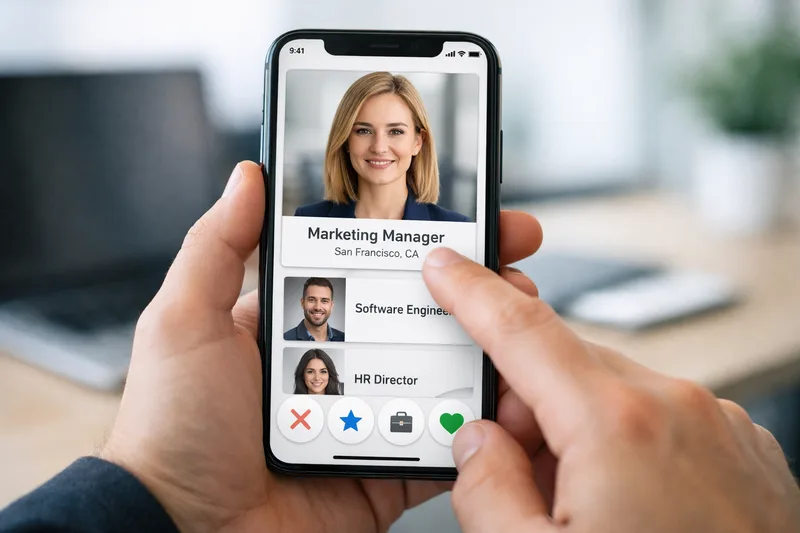
When job seekers start using dating apps to land interviews, it’s tempting to treat it as a quirky headline. But it’s not funny — it’s a symptom. A symptom of a job market so broken that qualified candidates are resorting to unconventional, even desperate, tactics just to be seen.
What’s Actually Happening
Reports have surfaced of candidates creating profiles on platforms like Bumble, Hinge, and Tinder — not to find a date, but to connect with hiring managers, recruiters, and industry professionals. The logic is simple: if your application disappears into a black hole on LinkedIn or Indeed, maybe a swipe right will get you a conversation.
Some candidates are open about it. Their bios say things like “Not here for romance — just trying to get hired.” Others are more subtle, hoping to build a connection that eventually leads to a referral or an introduction. Either way, the intent is the same: bypass a system that no longer works.
Why Traditional Channels Are Failing
The modern job application process is, for many candidates, an exercise in futility. A single job posting on a major platform can attract hundreds or even thousands of applications. Applicant tracking systems (ATS) filter most of them out before a human ever sees them. Keywords, formatting, and algorithmic quirks determine who advances — not necessarily who’s most qualified.
For candidates, this means spending hours tailoring CVs and cover letters for roles they may never hear back about. The feedback loop is broken: apply, wait, hear nothing, repeat. After weeks or months of silence, it’s not surprising that some people look for alternative ways in.
The Recruiter Bottleneck
On the recruiter side, the volume problem is real. Hiring teams are overwhelmed with applications, many of which are irrelevant or poorly matched. The tools meant to help — ATS platforms, AI screening, automated rejection emails — often make the experience worse for candidates without significantly improving outcomes for employers.
Recruiters are also stretched thin. Many are handling dozens of open roles simultaneously, with pressure to fill positions quickly. This leaves little time for thoughtful evaluation, and creates a bias toward candidates who are easy to process: recognizable brands on their CV, clean formatting, obvious keyword matches.
The Networking Trap
The standard advice to job seekers is “network.” And it’s true — referrals remain the most effective way to get hired. But networking is not equally accessible. It favors people who are already connected, already visible, and already in the right rooms. For candidates who are new to a market, changing industries, or simply introverted, the advice to “just network” can feel hollow.
Dating apps, in a strange way, democratize access. They bypass gatekeepers, create one-on-one connections, and allow people to present themselves directly. The fact that candidates are using them for professional purposes says less about the candidates and more about the walls they’re trying to get around.
What This Means for Employers
If your hiring process is so opaque, so impersonal, and so unresponsive that candidates are looking for you on Bumble, that’s not a candidate problem. That’s a systems problem.
Employers need to ask uncomfortable questions:
- Are we actually reviewing the applications we receive, or just filtering them?
- Do candidates know where they stand in our process, or are we leaving them in silence?
- Are we accessible to talent that doesn’t come through traditional channels?
- Is our employer brand strong enough that people want to apply — or are they applying out of desperation?
What This Means for the Industry
In hospitality specifically, where personal connection and communication skills are core to the work, the irony is sharp. An industry built on welcoming people is often terrible at welcoming candidates. Application processes are clunky, response times are slow, and the human element — the thing hospitality is supposed to be best at — is missing from the hiring experience.
If a candidate can get a faster, more personal response on a dating app than from a job application, the industry has a credibility problem.
The Bigger Picture
This trend is not about dating apps. It’s about access. It’s about a generation of job seekers who have been trained to believe that traditional applications don’t work — because, for many of them, they don’t. And it’s about a hiring ecosystem that has prioritized efficiency over effectiveness, automation over connection, and speed over quality.
The solution isn’t to mock candidates for being creative. It’s to fix the system that made creativity necessary. That means faster response times, transparent processes, better use of technology, and — most importantly — treating candidates like people, not ticket numbers.
Because when someone swipes right on a recruiter just to get a callback, the joke isn’t on them. It’s on us.